

MODIFICATION OF EXERCISES TO ALLOW INJURED INDIVIDUALS TO CONTINUE TRAINING
The following is an exclusive excerpt from the NSCA’s Essentials of Tactical Strength and Conditioning, published by Human Kinetics. All text and images provided by Human Kinetics.
Although the harmful effects of disuse on muscle size and strength are well documented, recent evidence shows that such effects begin to occur with as little as five days of disuse. Clearly, it is in the tactical athlete's interest to continue training to the extent possible after injury. Mobility is also frequently compromised after injury; however, the rehabilitation staff members usually direct restoration of mobility during the postinjury period. Therefore, the focus of this section is on preserving strength and motor control after injury. Though a full discussion of resistance training for the tactical athlete is covered in other chapters, it is instructive to note at this point the distinction between isolated and integrated resistance training.
Shoulder
Efficient use of the shoulder demands mobility and stability of the articulation between the scapula and the thorax. The scapula serves as the base of support for upper extremity movement. If it is not in the right place at the right time, or if it shifts too easily under load, then excessive strain is transmitted to the shoulder joint.
Although optimizing motion and stability of the scapula is a rehabilitation concern, TSAC Facilitators should recognize the role of the scapula and observe for optimal mechanics during all activities. Once scapular mechanics are sufficient, traditional upper body exercises may begin. Frequently, pressing movements must be modified to accommodate shoulder pathology. Dumbbells or kettlebells are usually preferable to the barbell in pressing movements because they allow the movement to occur in the scapular plane rather than the frontal plane. Note the arm and dumbbell angle in figure 16.13.
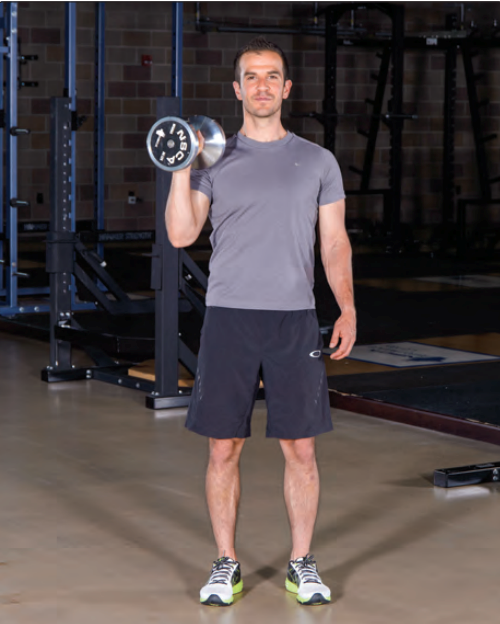
Figure 16.13 Starting position for dumbbell press in the scapular plane.
For people who experience a painful arc of motion during pressing activities (usually 60°-120° and commonly diagnosed as impingement), the push press allows the weight to move through the range with minimal shoulder strain. Once the weight is overhead and aligned, many tactical athletes with shoulder conditions tolerate a variety of total body exercises such as the single-arm overhead split squat, shown in figure 16.14. For such overhead exercises, the elbow is straight and the head and spine are aligned perpendicular to the ground. The TSAC Facilitator should also monitor overhead exercises for excessive elevation of the scapula. Common cues are "pack the scapula" or "place your shoulder blade in your back pocket." However, those cues should not be used until the arm is fully overhead; otherwise the exerciser might not achieve sufficient upward rotation of the scapula.
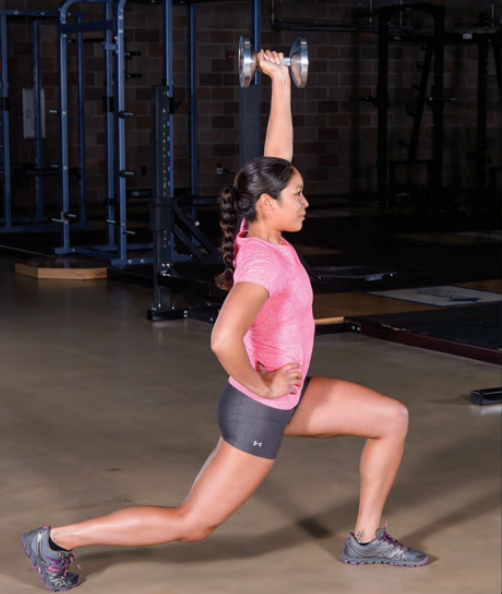
Figure 16.14 Single-arm overhead split squat.
Anterior instability is another common shoulder problem for tactical athletes. The primary precaution is to avoid horizontal abduction and external rotation (high-five position). The dumbbell floor press (figure 16.15) uses the floor to limit horizontal abduction, although bench-pressing with a barrier on the chest achieves a similar effect. People with anterior shoulder instability should avoid behind-the-neck presses or pulldowns; this is a sound precaution for shoulder protection in general.
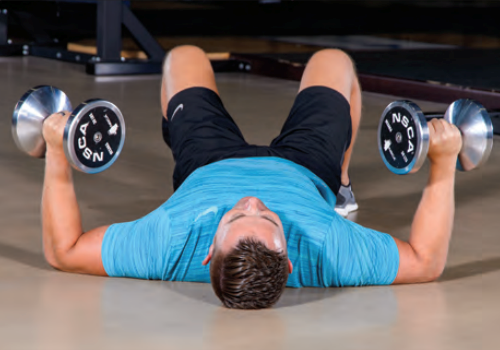
Figure 16.15 Dumbbell floor press.
Posterior instability of the shoulder is less common. The primary precaution is to prevent forces that drive the arm posteriorly. Pressing movements require excellent control of the scapula, which should be trained during rehabilitation. Initial pressing activities are modified, using only a wide grip to promote a congruent position of the humerus and scapula.
Using a cable system to train reciprocal push - pull movements can train rotation of the entire kinetic chain (see figure 16.16). Note the weight shift and rotation of the hips, pelvis, midback, and shoulder girdle. Very little motion occurs in the lower back. This exercise is also effective for training neuromuscular control of the shoulders. The TSAC Facilitator should cue the tactical athlete to lead with retraction of the scapula (and follow with the arm) on the pulling side. On the pushing side, care is taken to ensure that the hand does not lag behind the forward rotation of the pelvis, trunk, and shoulder girdle. Note also in figure 16.16 that adjustment of the pulley height and direction of the hand movement should be considered in light of the tactical athlete's unique needs. For example, some individuals will better tolerate a lower finishing position of the pushing arm compared to that shown in figure 16.16.
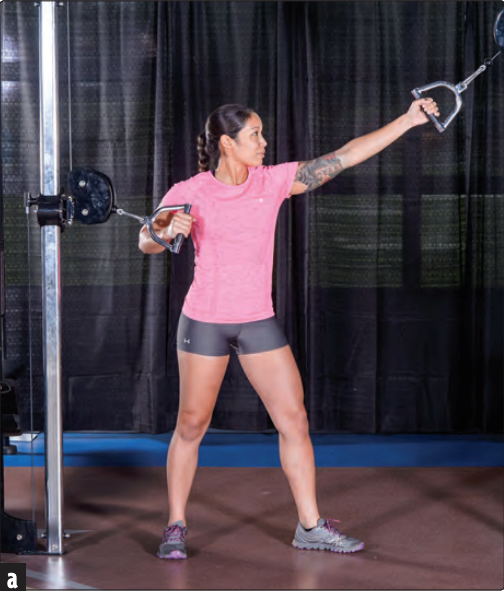
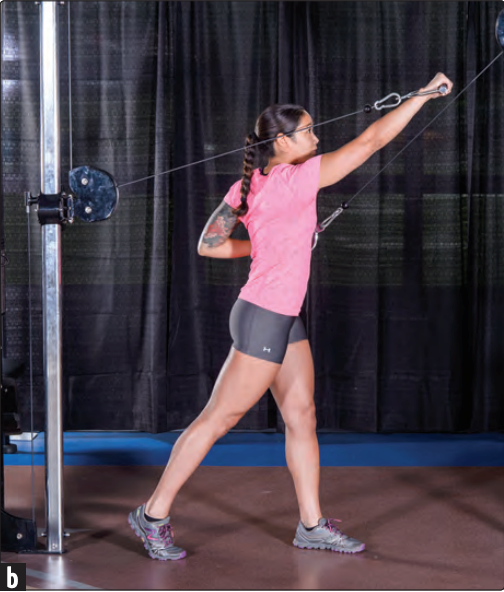
Figure 16.16 Reciprocal push – pull: (a) starting position; (b) final position.
The following suggestions are offered to tactical athletes looking to manage shoulder problems:
-
- Carefully consider the volume and intensity of pressing movements. Although the bench press is a staple of resistance training in tactical populations, large compressive and shearing loads are common. The TSAC Facilitator and the tactical athlete must perform a risk-to-benefit analysis. It is best to train pressing movements that contribute to function and are modified to accommodate individual restrictions. Always use strict, mechanically correct form, and choose a conservative progression of volume and intensity.
- The clean and jerk, snatch, and overhead squat are commonly performed by tactical athletes, but they come with some risk to the shoulders and spine. Master the coordination of those lifts with feedback from an exercise professional and quality reps with a light weight. If the tactical athlete does not demonstrate effective technique using a lightweight stick or bar, loaded overhead movements should not be attempted.
- Kettlebell get-ups may be used in the functional phase to integrate stability of the shoulder, core, and legs. As with any complex movement, approach the learning process with the intent of achieving mastery part by part and in due time, not in minutes. While developing technical mastery of the exercise, keep the load modest and avoid a high level of fatigue.
- Carefully consider the volume and intensity of pressing movements. Although the bench press is a staple of resistance training in tactical populations, large compressive and shearing loads are common. The TSAC Facilitator and the tactical athlete must perform a risk-to-benefit analysis. It is best to train pressing movements that contribute to function and are modified to accommodate individual restrictions. Always use strict, mechanically correct form, and choose a conservative progression of volume and intensity.

- Privacy Policy
- Your Privacy Choices

- Terms of Use
- Retraction and Correction Policy
- © 2026 National Strength and Conditioning Association