

Using Intensity Based on Sets and Repetitions – Over 50 Years of Experience: A Brief Overview of Load Setting and Programming Strategy
by Michael Stone, PhD, CSCS,*D, FUKSCA, FNSCA, William Hornsby, PhD, CSCS,*D, RSCC*D, FNSCA, Jacob Reed, PhD, CSCS, Meg Stone, MA, CSCS,*D, RSCC*E, FNSCA*E, Marco Duca, PhD, CSCS, Satoshi Mizuguchi, PhD, CSCS, and Kyle Pierce, PhD, CSCS
NSCA Coach
December 2025
Vol 12, Issue 3
This article offers a brief description of various methodsfor setting resistance training loads, using the percentage ofset and repetition best strategy.
INTRODUCTION
CONSIDER:
- Every good coach (and sport scientist) considers fatigue and performance fluctuations to a point.
- Question arise: How are these daily fluctuations determined? How does one determine how much importance should be placed on them?
Currently there are many methods being used to set the loading for strength-power training (39). The following provides rationale and limitations for these methods. We have not intended to provide a detailed critical analysis of different methods of setting strength-power training loads, but to briefly discuss using intensity for sets and repetitions and the reasoning for its use. For a more detailed discussion of methods of load setting, see Suchomel et al. (38).
The creation of this method (intensity based on sets and repetitions) began in 1977. Kyle Pierce and Mike Stone were the “Olympic” strength coaches at Louisiana State University in 1977. Pierce was also a doctoral student, Stone was also an assistant professor in the Department of Health, Physical Education, Recreation and Dance. Both of them were competitive weightlifters and both had a background in college track and field. At that time, there were two primary methods of setting loads: using repetition maximum (RM) (training to failure on the last set) values and using relative loads based on a percentage of the 1RM. They realized that these methods, particularly the RM method, had limitations. Thus, Pierce and Stone began a series of observations using both trained and untrained subjects with the goal of creating a better method of setting loads. The following discussion briefly outlines some of the rationale and limitations associated with the two methods prevalent in 1977 and more current ideas concerning setting loads for various set and repetition schemes.
PERCENT OF 1RM (RELATIVE INTENSITY)
RATIONALE:
The use of a percentage of 1RM providing a relative intensity (RI) has been a standard practice around the world for many years. It is simple to calculate and prescribe loads, and is easily understood by most coaches and sport scientists. The RI can be calculated by multiplying the 1RM by a percent. For example, if an athlete’s 1RM squat is 200 kg, then training at an RI of 90 % would be 200 kg x 0.90 = 180 kg.
-
- Generally, most untrained and trained athletes can perform about the same number of repetitions at a given RI (31).
- There can be differences between males and females and larger multi-joint exercise typically result in more repetitions than smaller muscle mass exercises (15,26).
- Some evidence indicates that endurance athletes can sometimes perform more repetitions at low RIs; however, this is not true of higher RIs (28).
- Thresholds for increased strength in advanced athletes appear to be > 80% 1RM (13).
- However, a recent review and meta-analysis indicated that there was little influence of sex, age, or training status on the repetition to %1RM relationship; thus, this model can be applied to most individuals and to all exercises (26).
PERCENT OF 1RM
POTENTIAL LIMITATIONS:
There are several potential limitations in the use of RI to set repetitions ranges.
-
- As previously indicated, at a given percentage of 1RM, particularly lower RIs, endurance athletes can perform a different number of repetitions (28).
- Although differences in repetitions are typically small for advanced strength-power athletes, especially at high loads, not all subjects/athletes are actually performing the same amount of work or power output. Stronger athletes will perform more work at the same RI (35).
- Fatigue can also alter the 1RM substantially (16).
- Beginners and novices increase their 1RM quite rapidly. As a result, periodic (sometimes frequent) measurement (or estimation) of the 1RM is necessary to adjust loading.
RM METHOD
RATIONALE:
This method is used quite often in many studies and to set loads for various training programs. For example, three sets of 8 – 12 repetitions were commonly prescribed (using this scenario, failure should occur during the last set) once all 12 repetitions can be performed, the weight is increased. The rationale is based on the observations that:
-
- Beginners progress too fast to base loads on the 1RM (3).
- At the same percentage of maximum, a different number of repetitions can be performed for different exercises (26,31).
- Different lifters can perform different numbers of repetitions at the same percentage for the same exercise (15,28).
- When failure is reached, it is believed that the athlete is always performing a relative maximum contraction and recruiting all the available motor units (34).
POTENTIAL LIMITATIONS:
-
- Promotes consistent training to failure (produces relative maximum consistently) difficult to manage accumulative fatigue, prolongs recovery, and potentially promotes non-functional overreaching and overtraining (5,7,24).
- Difficult to prescribe a given “dose” (i.e., workload).
- At different times, the same athlete can perform a different number of repetitions with the same weight. So, inconsistent values for work/power output can occur and, therefore, not everyone is performing the same relative work or power output as the set and repetition scheme is altered with fatigue (25).
- Several reviews and studies have indicated methods using training to failure produce equal or often inferior strength-power results compared to not training to failure (7,23,30,42), and generally inferior results, particularly for strength and power when volume is not equated (11,42).
AUTOREGULATION
RATIONALE:
Autoregulation is a recently revised idea, which has been around since at least the 1940s (8). Autoregulation is a resistance training prescription approach attempting to adjust training variables based on an individual’s daily fluctuations in performance, which are a result of training-induced fitness and fatigue, together with readiness from daily non-training stress (10,18). Typical methods of autoregulation include repetitions in reserve (RIR) and velocity-based training (VBT).
REPETITIONS IN RESERVE
RATIONALE:
The proximity to failure to which a resistance training set is taken, or the number of repetitions in reserve at the end of a set, can substantially impact the rate of muscle hypertrophy and strength adaptation.
-
- At a given absolute or relative load, individuals can perform a different number of repetitions.
- If every athlete terminates a set with the same number of RIR, they should have a similar training effect.
- Load is prescribed based on a given RIR number.
- Autoregulation is highly context-specific and should be viewed as an adjunct to existing practice, rather than as an alternative or a replacement.
POTENTIAL LIMITATIONS:
-
- Researchers have used various methods to control for proximity to failure and have used various definitions of the term “failure” itself. Because of the varying methods and definitions of failure, there is considerable ambiguity in the number of RIR per set individuals can train to maximize hypertrophy and strength (27).
- Based on meta-analysis, the dose-response relationship between proximity to failure for strength gains appears to be different from its relationship to muscle hypertrophy alterations. Based on meta-analysis, it appears that only hypertrophy is meaningfully impacted by RIR. Strength gains appear to be similar across a wide range of RIR, while muscle hypertrophy is enhanced as sets are terminated closer to failure. Considering the RIR estimation procedures used, which are not consistent or always clear, the exact relationship between RIR and muscle hypertrophy and strength remains imprecise at best (29).
- If the athlete predicts the RIR for a given load before initiation of the set, they potentially bias themselves and may limit RIR to what they predict or very close.
- If the athlete call out how many repetitions they have in reserve in the middle of the set, then this could change the athlete’s focus and potentially alter performance.
- If the athlete stops at some point during a set to state, “I have X RIR,” how does the investigator know they could not perform more (or less)?
- If velocity stops are used to help predict RIR based upon the load-velocity relationship, this does not appear to work proficiently because of the innate issues with VBT (18).
- RIR reliability has not been shown to be particularly effective, although it appears to improve with training and as the load approaches maximum (9,14,20,32).
VELOCITY-BASED TRAINING
RATIONALE:
-
- VBT is a method of determining the velocity of movement, in real time, and involves adjusting the load of an exercise accordingly (17). Tracking velocity necessitates the use of an instrument.
- Currently, the most commonly used instrumentation appears to be linear position transducers and accelerometers, typical examples of which are the GymAware device and the PUSH Band. VBT often uses a method of predicting 1RM through use of a minimum velocity of movement. Either peak or mean velocity can be used; however, mean velocity appears to be more stable (6).
- Initially, velocity is measured for a number of loads that are a percentage of the athlete’s 1RM. A best fit line is used to predict (interpellated) the intersection of velocity measured for each load and the load representing 1RM (Figure 1).
- For training, intensity zones have been created based on a percentage of the predicted 1RM (22). These zones can be used for training different aspects of performance fitness such as speed-strength, acceleration, and maximum strength. Slightly different velocities may be found in the literature used depending upon the author; however, the basic principle is the same.
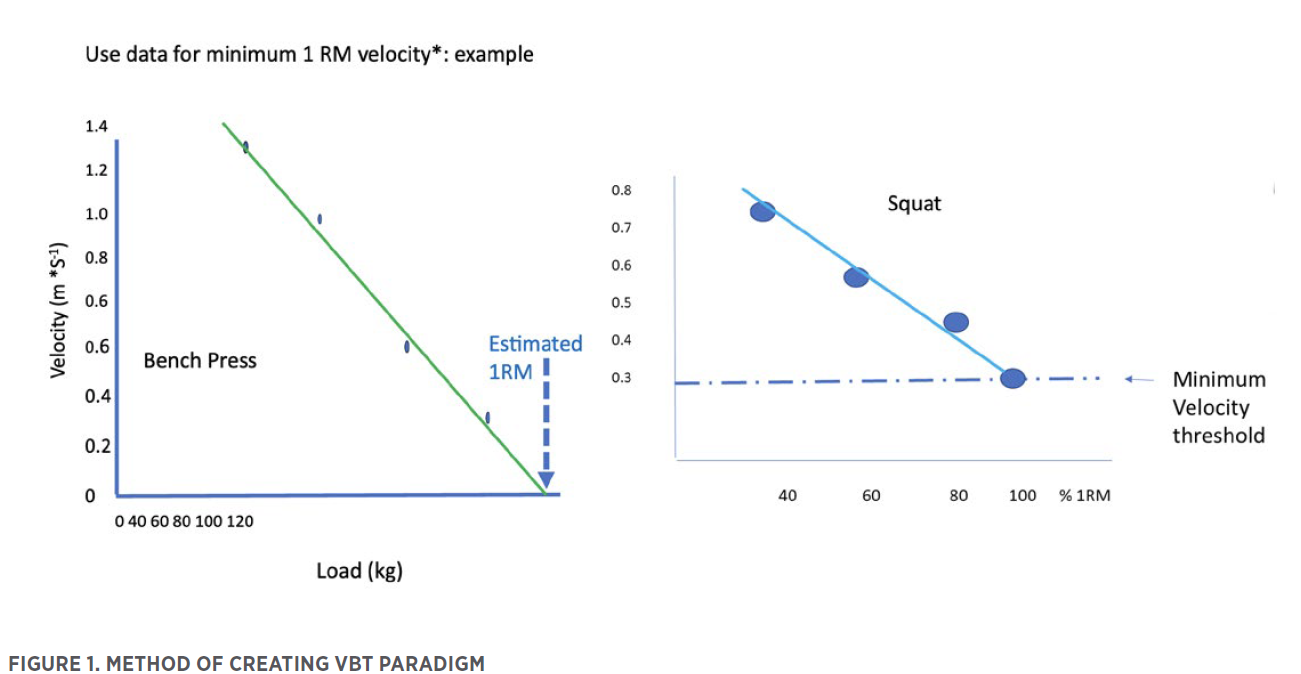
This method requires velocity profiling (Figure 1):
POTENTIAL LIMITATIONS:
-
- There can be reliability and theoretical problems.
- Depends on the device used, and devices are often relatively expensive (1,21).
- Some studies and reviews have found good reliability (44), but may need caution as displacement accuracy may be suspect (2,43).
- Other studies and reviews have found relatively poor reliability (12,22,33,40,43).
- Banyard et al. showed that the actual measured 1RM was more stable than the prediction for 1RM and particularly for percentages of 1RM (three separate days); primarily as a result of substantial velocity changes from day to day (N = 17) (4).
- Vernon et al. support Banyard et al.’s contention as they note that when using VBT measures, meaningful variability of the mean velocity and peak velocity may last up to 96 hr after strength- or power-oriented training sessions (n = 15) (4,41).
- Indeed, the entire conceptual basis of VBT may be questionable (19).
USE OF PERCENTAGES OF SETS AND REPETITIONS
RATIONALE:
-
- The authors have been using this method successfully, in both research and training, for nearly 50 years (7,36,37).
- Workloads are easy to calculate.
- Obviates accumulative differences in 1RM
- To an extent, it obviates differences in performance (repetitions to failure and velocity) at different percentages because differences have already been accounted for by establishing (estimation) a maximum for a given (individualized autoregulation) set and repetition protocol.
- Relatively easy to plan progression.
- To an extent, it accommodates for fatigue levels (intensity and loading range) as a type of autoregulation.
In order to implement this method, the 1RM (or a reliable estimate) must be first measured. In 1978, Pierce and Stone made observations using weight training classes, dealing with the 1RM and its relationship to being able to complete various set repetition routines, primarily using the squat and bench press (36). The results are shown in Table 1. Later (1978 – 1979), using advanced weightlifters and throwers, the data shown in Table 1 was corroborated.
This observation was repeated by Jacob Reeves, then a PhD student at East Tennessee State University. Using the volleyball team, he found the same result (36). The data presented in Table 1 represent a guideline of values for set and repetition protocols so that every athlete could achieve the prescribed protocol. While these values may be very heavy for some athletes, this can be easily adjusted by the strength and conditioning coach to provide the required stimulus. These general guidelines were carefully worked out and have been used over several years. Each protocol can be further divided into intensity ranges such that intensity and work can be manipulated in a reasonable manner (Table 2). Table 3 provides an example of this method. Using this table allows easy construction of heavy and light days (35).
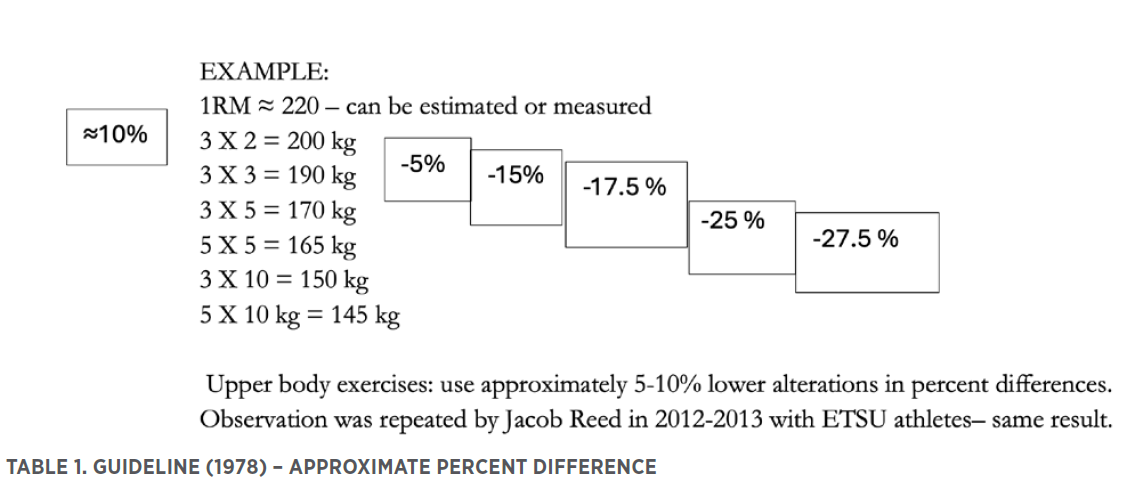
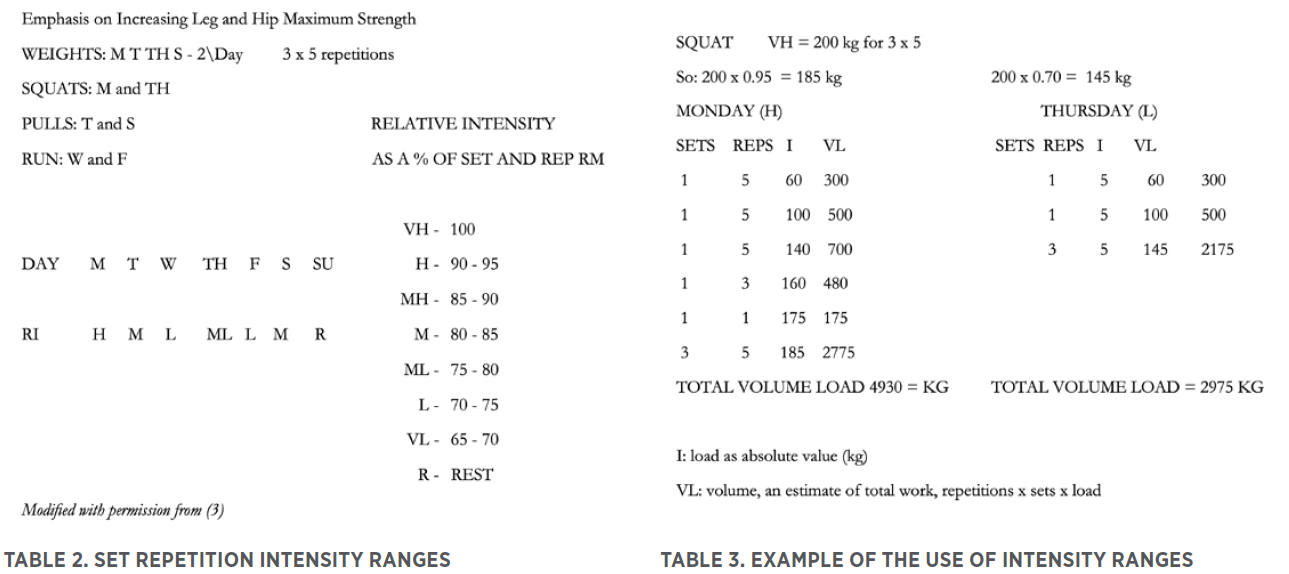
It is important to note that the percentage differences are guidelines. Adjustments for optimal repetition ranges can be made (usually within a week) as training proceeds. Demonstratable session accumulation (e.g., struggling to accomplish the exercise protocol in the previous session, athlete monitoring) or subjective fatigue can be partially accounted for by using the intensity ranges.
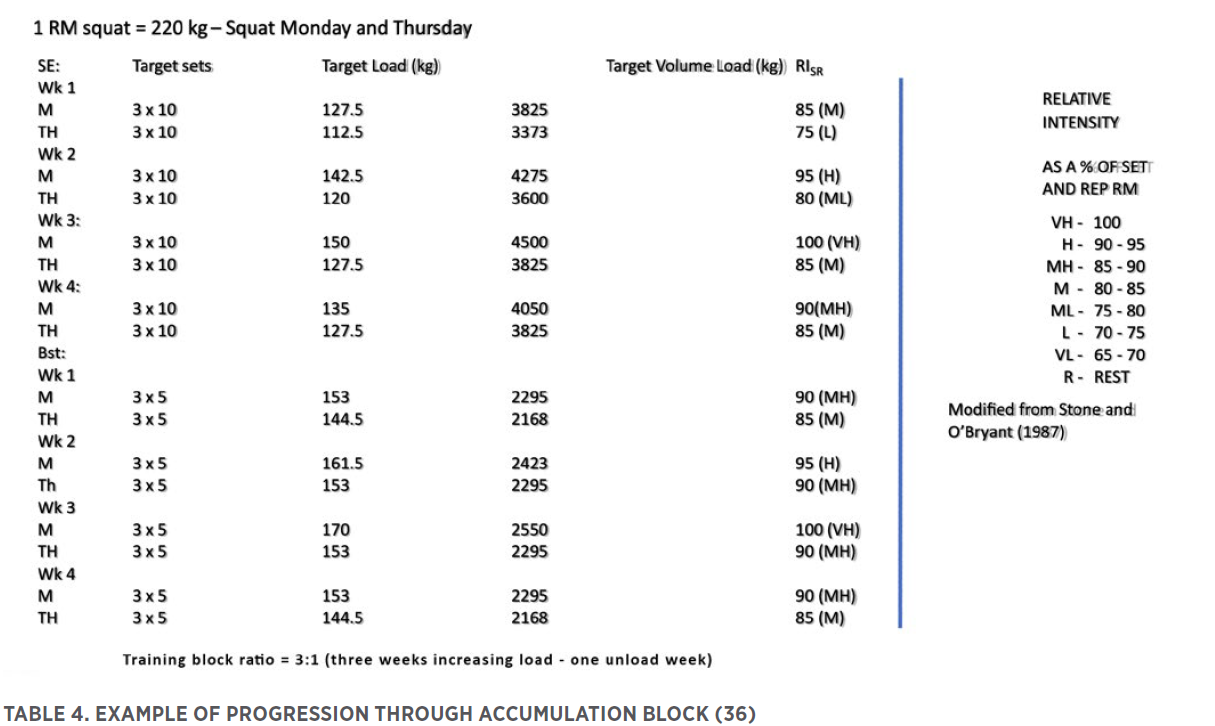
In this context, again note that there is a range established in the intensity table (Table 2). For example, a “very heavy” (VH) day is estimated to be 3 x 5 = 170 kg and the present session is at “medium heavy” (MH), then; 170 x 0.90 = 153 kg or 170 x 0.85 = 145 kg depending on the level of fatigue. Therefore, the athlete would perform 3 x 5 with 145 – 153 kg. If the athlete is not performing at their best, use the lower weight. Importantly, the athlete should not make judgement of load selections only based on their “subjective” feelings; they should start warming up first, consult with their strength and conditioning coach, then make a more educated decision—a reasonable form of autoregulation. An example of the progression across two concentrated loads is provided in Table 4.
POTENTIAL LIMITATIONS:
- It can take a little time and work to understand the basic concept.
- Sometimes somewhat difficult to implement, especially with new athletes, and arrive at good estimation of repetition RMs.
- In a sport setting, it initially requires somewhat more time and effort on the strength and conditioning staff to recognize and address all of the athletes’ strengths and weaknesses.
SUMMARY
This article has offered a brief description of various methods for setting resistance training loads. The discussion has focused on implementing relative intensities using the percentage of set and repetition best strategy. It is the opinion of the authors that this method provides several advantages not shared by the other methods.
This article originally appeared in NSCA Coach, a quarterly publication for NSCA Members that provides valuable takeaways for every level of strength and conditioning coach. You can find scientifically based articles specific to a wide variety of your athletes’ needs with Nutrition, Programming, and Youth columns. Read more articles from NSCA Coach »
Related Reading
REFERENCES
- Abbott, JC, Wagle, JP, Sato, K, Painter, K, Light, TJ, and Stone, MH. Validation of inertial sensor to measure barbell kinematics across a spectrum of loading conditions. Sports 8(7): 93, 2020.
- Appleby, B, Banyard, H, Cormack, SJ, and Newton, RU. Validity and reliability of methods to determine barbell displacement in heavy back squats: Implications for velocity-based training. Journal of Strength and Conditioning Research 34(11): 3118-3123, 2020.
- Asano, RY, Levada-Pires, AC, de Moraes, JFVN, Sales, MM, Coelho, JM, Neto, WB, et al. American College of Sports Medicine strength training and responses in beginners. Journal of Exercise Physiology Online15(5): 1-9, 2012.
- Banyard, HG, Nosaka, K, and Haff, GG. Reliability and validity of the load–velocity relationship to predict the 1RM back squat. Journal of Strength and Conditioning Research 31(7): 1897-1904, 2017.
- Bell, L, Ruddock, A, Maden-Wilkinson, T, and Rogerson, D. Overreaching and overtraining in strength sports and resistance training: A scoping review. Journal of Sports Sciences38(16): 1897-1912, 2020.
- Benavides-Ubric, A, Díez-Fernández, DM, Rodríguez-Pérez, MA, Ortega-Becerra, M, and Pareja-Blanco, F. Analysis of the load-velocity relationship in deadlift exercise. Journal of Sports Science and Medicine 19(3): 452-459, 2020.
- Carroll, KM, Bernards, JR, Bazyler, CD, Taber, CB, Stuart, CA, DeWeese, BH, et al. Divergent performance outcomes following resistance training using repetition maximums or relative intensity. International Journal of Sports Physiology and Performance14(1): 46-54, 2019.
- Delorme, TL. Restoration of muscle power by heavy resistance exercise. Journal of Bone and Joint Surgery 27(4): 645-667, 1946.
- García-Ramos, A, Torrejón, A, Feriche, B, Morales-Artacho, AJ, Pérez-Castilla, A, Padial, P, and Haff, GG. Prediction of the maximum number of repetitions and repetitions in reserve from barbell velocity. International Journal of Sports Physiology and Performance 13(3): 353-359, 2018.
- Greig, L, Stephens Hemingway, BH, Aspe, RR, Cooper, K, Comfort, P, and Swinton, PA. Autoregulation in resistance training: Addressing the inconsistencies. Sports Medicine 50: 1873-1887, 2020.
- Grgic, J, Schoenfeld, BJ, Orazem, J, and Sabol, F. Effects of resistance training performed to repetition failure or non-failure on muscular strength and hypertrophy: A systematic review and meta-analysis. Journal of Sport and Health Science11(2): 202-211, 2022.
- Guppy, SN, Kendall, KL, and Haff, GG. Velocity-based training—A critical review. Strength and Conditioning Journal 16: 1510-1519, 2022.
- Häkkinen, K, Komi, PV, Alén, M, and Kauhanen, H. EMG, muscle fibre and force production characteristics during a 1 year training period in elite weight-lifters. European Journal of Applied Physiology and Occupational Physiology56: 419-427, 1987.
- Hickmott, LM, Butcher, SJ, and Chilibeck, PD. A comparison of subjective estimations and objective velocities at quantifying proximity to failure for the bench press in resistance-trained men and women. Journal of Strength and Conditioning Research 38(7): 1206-1212, 2024.
- Hoeger, WW, Hopkins, DR, Barette, SL, and Hale, DF. Relationship between repetitions and selected percentages of one repetition maximum: A comparison between untrained and trained males and females. Journal of Strength and Conditioning Research4(2): 47-54, 1990.
- Hooper, DR, Szivak, TK, Comstock, BA, Dunn-Lewis, C, Apicella, JM, Kelly, NA, et al. Effects of fatigue from resistance training on barbell back squat biomechanics. Journal of Strength and Conditioning Research28(4): 1127-1134, 2014.
- Jovanović, M, and Flanagan, EP. Researched applications of velocity based strength training. Journal of Australian Strength and Conditioning 22(2): 58-69, 2014.
- Larsen, S, Kristiansen, E, and van den Tillaar, R. Effects of subjective and objective autoregulation methods for intensity and volume on enhancing maximal strength during resistance-training interventions: A systematic review. PeerJ 9: e10663, 2021.
- Loturco, I, Pereira, LA, and Pareja-Blanco, F. Training at different velocity zones: Does it really matter? International Journal of Sports Physiology and Performance 1-5, 2025.
- Mansfield, SK, Peiffer, JJ, Galna, B, and Scott, BR. The velocity of resistance exercise does not accurately assess repetitions-in-reserve. European Journal of Sport Science 23(12): 2357-2367, 2023.
- Martínez-Cava, A, Hernández-Belmonte, A, Courel-Ibáñez, J, Morán-Navarro, R, González-Badillo, JJ, and Pallarés, JG. Reliability of technologies to measure the barbell velocity: Implications for monitoring resistance training. PloS One 15(6): e0232465, 2020.
- Martínez-Cava, A, Morán-Navarro, R, Sánchez-Medina, L, González-Badillo, JJ, and Pallarés, JG. Velocity- and power-load relationships in the half, parallel and full back squat. Journal of Sports Science 37(10): 1088-1096, 2019.
- Martorelli, S, Cadore, EL, Izquierdo, M, Celes, R, Martorelli, A, Cleto, VA, et al. 2017. Strength training with repetitions to failure does not provide additional strength and muscle hypertrophy gains in young women. European Journal of Translational Myology27(2): 6339, 2017.
- Morán-Navarro, R, Pérez, CE, Mora-Rodríguez, R, de la CruzSánchez, E, González-Badillo, JJ, Sánchez-Medina, L, and Pallarés, JG. Time course of recovery following resistance training leading or not to failure. European Journal of Applied Physiology117: 2387-2399, 2017.
- Nóbrega, SR, and Libardi, CA. Is resistance training to muscular failure necessary? Frontiers of Physiology 7: 10, 2016.
- Nuzzo, JL, Pinto, MD, Nosaka, K, and Steele, J. Maximal number of repetitions at percentages of the one repetition maximum: A meta-regression and moderator analysis of sex, age, training status, and exercise. Sports Medicine54(2): 303-321, 2024.
- Pelland, JC, Robinson, ZP, Remmert, JF, Cerminaro, RM, Benitez, B, John, TA, et al. Methods for controlling and reporting resistance training proximity to failure: Current issues and future directions. Sports Medicine 52(7): 1461-1472, 2022.
- Richens, B, and Cleather, DJ. The relationship between the number of repetitions performed at given intensities is different in endurance and strength trained athletes. Biology of Sport31(2): 157-161, 2014.
- Robinson, ZP, Pelland, JC, Remmert, JF, Refalo, MC, Jukic, I, Steele, J, and Zourdos, MC. Exploring the dose–response relationship between estimated resistance training proximity to failure, strength gain, and muscle hypertrophy: A series of metaregressions. Sports Medicine54(9): 2209-2231, 2024.
- Sampson, JA, and Groeller, H. Is repetition failure critical for the development of muscle hypertrophy and strength? Scandinavian Journal of Medicine and Science in Sports 26(4): 375-383, 2016.
- Shimano, T, Kraemer, WJ, Spiering, BA, Volek, JS, Hatfield, DL, Silvestre, R, et al. Relationship between the number of repetitions and selected percentages of one repetition maximum in free weight exercises in trained and untrained men. Journal of Strength and Conditioning Research20(4): 819-823, 2006.
- Sinclair, J. The efficacy of repetitions-in-reserve vs. traditional percentage-based resistance training: A 4-week pre-season randomized intervention in elite rugby league players. Sport Sciences for Health 1-11, 2022.
- Soriano, MA, Jiménez-Ormeño, E, Haff, GG, Comfort, P, Giráldez-Costas, V, Ruiz-Moreno, C, and García-Ramos, AA. comparison of three load-velocity based methods to estimate maximum overhead press performance in weightlifters. International Journal of Sports Science and Coaching 18(5): 1585-1593, 2023.
- Stone, MH, Chandler, TJ, Conley, MS, Kramer, JB, and Stone, ME. Training to muscular failure: Is it necessary? Strength and Conditioning Journal18(3): 44-48, 1996.
- Stone, MH, Hornsby, WG, Haff, GG, Fry, AC, Suarez, DG, Liu, J, et al. Periodization and block periodization in sports: Emphasis on strength-power training—A provocative and challenging narrative. Journal of Strength and Conditioning Research 35(8): 2351-2371, 2021.
- Stone, MH, and O’Bryant, H. Weight Training: A Scientific Approach (2nd ed.), Minneapolis, MN: Burgess Publishing; 1987.
- Stone, MH, O’Bryant, H, and Garhammer, J. A hypothetical model for strength training. Journal of Sports Medicine and Physical Fitness 21: 342351, 1981.
- Suchomel, TJ, Nimphius, S, Bellon, CR, and Stone, MH. The importance of muscular strength: Training considerations. Sports Medicine 48, 765-785, 2018.
- Suchomel, TJ, Nimphius, S, Bellon, CR, Hornsby, WG, and Stone, MH. Training for muscular strength: Methods for monitoring and adjusting training intensity. Sports Medicine51(10): 2051-2066, 2021.
- Valenzuela, PL, Sánchez-Martínez, G, Torrontegi, E, Vázquez-Carrión, J, Montalvo, Z, and Haff, GG. Should we base training prescription on the force–velocity profile? Exploratory study of its between-day reliability and differences between methods. International Journal of Sports Physiology and Performance 16(7): 1001-1007, 2021.
- Vernon, A, Joyce, C, and Banyard, HG. Readiness to train: Return to baseline strength and velocity following strength or power training. International Journal of Sports Science and Coaching15(2): 204-211, 2020.
- Vieira, AF, Umpierre, D, Teodoro, JL, Lisboa, SC, Baroni, BM, Izquierdo, M, and Cadore, EL. Effects of resistance training performed to failure or not to failure on muscle strength, hypertrophy, and power output: A systematic review with meta-analysis. Journal of Strength and Conditioning Research 35(4): 1165-1175, 2021.
- Wagner, CM, Keiner, M, Puschkasch-Möck, S, Wirth, K, Schiemann, S, and Warneke, K. Can the velocity profile in the bench press and the bench pull sufficiently estimate the one repetition maximum in youth elite cross-country ski and biathlon athletes? BMC Sports Science, Medicine and Rehabilitation 17(1): 1-11, 2025.
- Weakley, J, Chalkley, D, Johnston, RD, García-Ramos, A, Townshend, A, Dorrell, H, et al. Criterion validity, and inter-unit and between-day reliability of the FLEX for measuring barbell velocity during commonly used resistance training exercises. Journal of Strength and Conditioning Research 34(6): 1519-1524, 2020.
Audience:
Coaches
Coaches
Topics:
Exercise Science Exercise Technique Program design Organization and Administration Testing and Evaluation Client Consultation|Assessment Safety Professional Development
Exercise Science Exercise Technique Program design Organization and Administration Testing and Evaluation Client Consultation|Assessment Safety Professional Development
Keywords:
Intensity Based Training Strength Coaches Power Lifting Fatigue repetitions in reserve (RIR) relative intensity (RI) repetition maximum (RM) velocity-based training (VBT),
Intensity Based Training Strength Coaches Power Lifting Fatigue repetitions in reserve (RIR) relative intensity (RI) repetition maximum (RM) velocity-based training (VBT),

- Privacy Policy
- Your Privacy Choices

- Terms of Use
- Retraction and Correction Policy
- © 2026 National Strength and Conditioning Association