

Assessment Protocols for Military Personnel, Firefighters, and Police Officers
by Robert Lockie, PhD, TSAC-F, Joseph Dulla, MA, TSAC-F,*D, Rachel Cassalia, PhD, CSCS,*D, TSAC-F,*D, Maj. Bradley J. Warr, PhD, MPAS, CSCS, Patrick Gagnon, MS, Dennis E. Scofield, MEd, CSCS,*D, and Suzanne Jaenen, MS
Other
January 2026
The following is an exclusive excerpt from the NSCA’s Essentials of Tactical Strength and Conditioning, Second Edition, published by Human Kinetics. All text and images provided by Human Kinetics.
SIT AND REACH
Flexibility can be important for tactical personnel in certain job tasks, such as when conducting searches (e.g., in cells, vehicles, rooms in houses) (43) and for manual handling (10). Hamstring flexibility has been found to decrease overuse injuries in military trainees (37), so this could also influence injury occurrence in other tactical personnel. Personnel who have to sit a lot during a work shift (e.g., in a vehicle or office) could experience negative effects on flexibility (11). The sit and reach specifically provides a measure of hamstring flexibility (48).
Equipment
-
- Sit-and-reach box
- Recording sheet or tablet
- Pen
- Wall or stable structure
- Flat surface
Personnel
One tester/recorder
Procedure
-
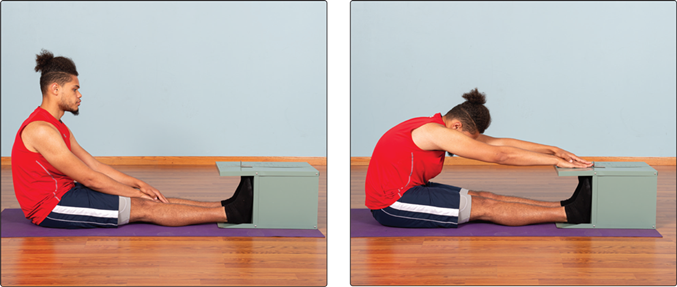
- The sit-and-reach box should be positioned against a wall or other solid structure or on a non-slip surface (e.g., a yoga mat).
- Move the slider to the end of the box.
- The participant should remove their shoes and sit with both feet flat against the sit-and-reach box with their knees extended.
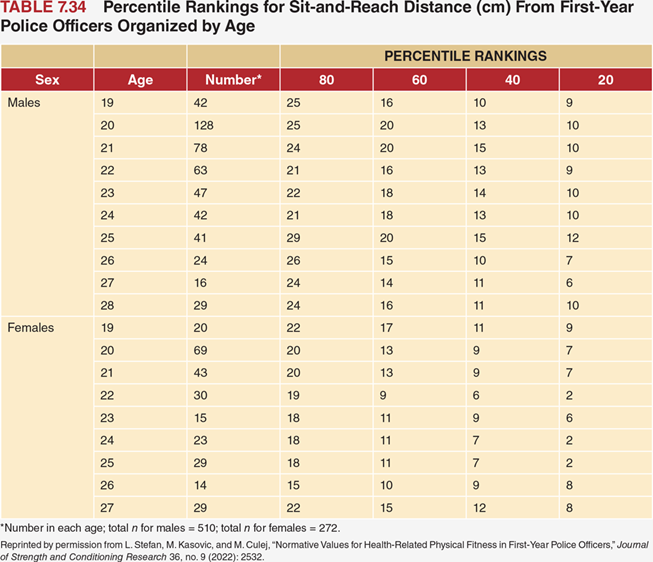
- Zero intersects the point where the feet are pressed against the box. A positive score measured indicates the participant can reach past their toes; a negative score indicates that the participant cannot reach past their toes.
- The hands should be positioned on top of each other with the tips of the middle fingers aligned and palms down.
- The tips of the middle fingers should contact the slide as the participant slowly flexes forward at the hips and pushes the slider as far along the scale as possible.
- The movement should be slow and controlled, and not a sudden push forward.
- The knees must remain extended throughout the reach, and the participant should hold the end position for 5 seconds.
- The point where the slider stops is the recorded distance.

- Privacy Policy
- Your Privacy Choices

- Terms of Use
- Retraction and Correction Policy
- © 2026 National Strength and Conditioning Association