

A Simple System for Managing Quality in Small and Medium Fitness Centers
by Xiao Ren, CSCS,*D, NSCA-CPT,*D, TSAC-F,*D, and Yu Yang, CSCS
Personal Training Quarterly
April 2026
Vol 13, Issue 1
This article discusses a Mini Quality System (MQS), an ISO 9001-inspired framework designed to help small and growing fitness centers establish better operational control.
Small and medium fitness centers (SMFCs) often operate with limited staff, informal procedures, and minimal documentation. While this approach may feel efficient day-to-day, it can create serious problems when something goes wrong. Inconsistent records, unclear processes, and ad hoc decision-making can compromise client safety, weaken legal defense, and erode trust—even in well-intentioned facilities.
The challenge is not a lack of professionalism or expertise, but the absence of a simple, structured system for managing quality and risk. Many SMFCs rely heavily on personal trainers’ experience rather than standardized processes, leading to inconsistent service delivery and increased liability exposure (11,15).
This article addresses that gap by introducing a Mini Quality System (MQS)—a practical, scaled-down quality management framework inspired by ISO 9001 and designed specifically for SMFCs. Rather than requiring full certification or extensive resources, the MQS focuses on applying core quality management principles in a way that is realistic and actionable for smaller facilities. By reading this article, personal trainers and facility owners will learn:
-
- Why quality management systems matter, even in small operations
- How ISO 9001 principles can be adapted to everyday fitness practice
- What essential processes and documents form an effective MQS
- How tools such as internal audits, document control, and client feedback can improve consistency, safety, and accountability
Ultimately, this article provides a clear roadmap for improving service quality, reducing risk, and strengthening long-term business sustainability—without overwhelming staff or budgets.
KEY PRINCIPLES OF ISO 9001
ISO 9001:2015 is a global standard for quality management used by over one million organizations worldwide, with the goal of ensuring operations are client-focused, measurable, and continuously improving. While commonly associated with manufacturing, ISO 9001 principles are also widely applied in healthcare and service-based industries (3). Rather than prescribing specific tools, ISO 9001 encourages organizations to define, monitor, and improve processes that consistently meet client needs (7).
THE SEVEN QUALITY MANAGEMENT PRINCIPLES
ISO 9001:2015 defines seven core principles (8):
-
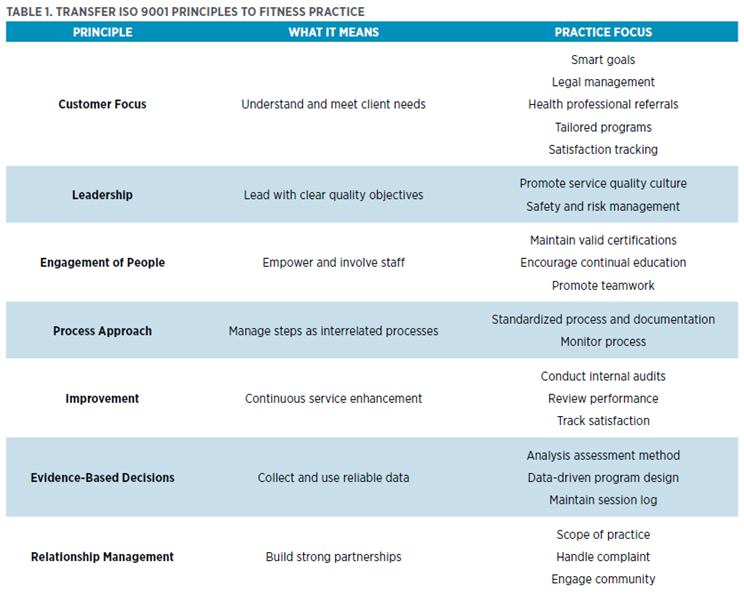
- Customer Focus– Prioritize client needs and satisfaction
- Leadership– Establish clear quality goals and accountability
- Engagement of People– Involve all staff in quality efforts
- Process Approach– Standardize and manage key workflows
- Improvement– Promote continuous enhancement
- Evidence-Based Decision Making– Use reliable data to guide decisions
- Relationship Management– Foster partnerships with clients and stakeholders
Although risk management is not listed as a standalone principle, risk-based thinking underpins all ISO 9001 principles. This approach requires organizations to proactively identify and mitigate potential failures.
APPLYING A MQS IN SMFCS
Achieving full ISO 9001 certification requires substantial investment in documentation, staffing, and financial resources—often beyond the reach of SMFCs. However, even without certification, applying ISO 9001 principles can significantly enhance quality, safety, and operational sustainability (4). The MQS integrates ISO 9001 principles with the authors’ applied experience. It includes both:
-
- Service processes (e.g., client onboarding, program delivery, feedback collection)
- Quality management processes (e.g., internal audits, document control)
This article outlines the key processes needed to build an MQS, designed primarily from a customer-oriented perspective and adaptable to each SMFC’s size, services, and risk profile.
TRANSLATING ISO 9001 PRINCIPLES INTO FITNESS PRACTICE
Designing an effective MQS requires translating ISO 9001 principles into daily operational practice. Table 1 illustrates how these principles can be interpreted within the context of fitness center operations.
DEVELOPING ESSENTIAL MQS PROCESSES AND DOCUMENTS
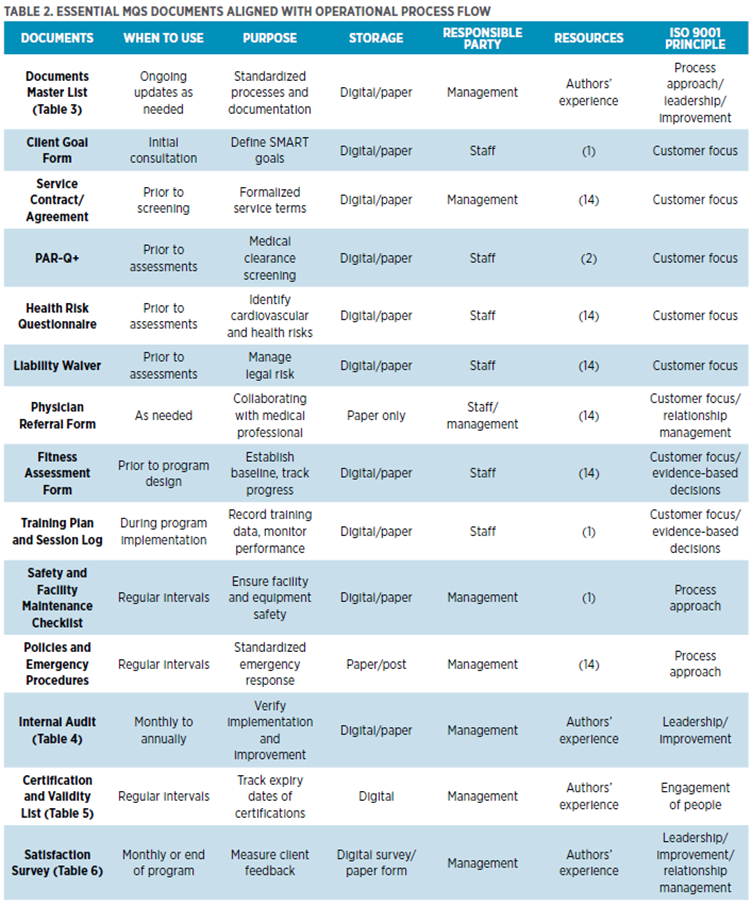
Once ISO 9001 principles are understood, the next step is identifying the essential documents that support daily operations.
The MQS follows a logical sequence, beginning with:
-
- Client onboarding
- Health screening
- Program implementation
- Feedback collection
- Quality review
Table 2 outlines the core documents aligned with each stage of this process, reflecting both ISO 9001 principles and the authors’ practical experience.
All MQS documents should be customized based on:
-
- Business size
- Client population
- Staff composition
Additionally, documents must align with local laws, policies, and cultural considerations. Legal counsel is recommended during document development.
FILLING GAPS IN PRACTICE: MQS OPERATIONAL TOOLS
Although the National Strength and Conditioning Association (NSCA) and other professional organizations provide general recommendations for professional conduct, training safety, and facility operations, they often fall short in addressing quality management systems.
To close these gaps, the MQS introduces several operational tools tailored to the unique challenges of SMFCs. These tools function as practical mechanisms to:
-
- Monitor service quality
- Reduce operational risk
- Support staff development
- Manage processes and documentation
MQS DOCUMENT CONTROL AND MANAGEMENT
All quality management system documents should be organized within a version-controlled master list to prevent outdated materials from being used. Table 3 presents a recommended structure for document control.
INTERNAL AUDITS
According to ISO 9001, internal audits are essential for verifying process adherence, ensuring documentation accuracy, and supporting continuous improvement (7). While ISO-certified organizations typically conduct full audits semiannually or annually, this frequency may be unrealistic for SMFCs during early MQS implementation. A more practical approach is to conduct monthly partial audits, each focusing on a specific process.
Once operational consistency is achieved, audit frequency can be reduced to balance quality oversight with limited staffing resources. Regardless of frequency, internal audits should:
-
- Be led by the facility owner or a designated supervisor
- Actively involve all staff members
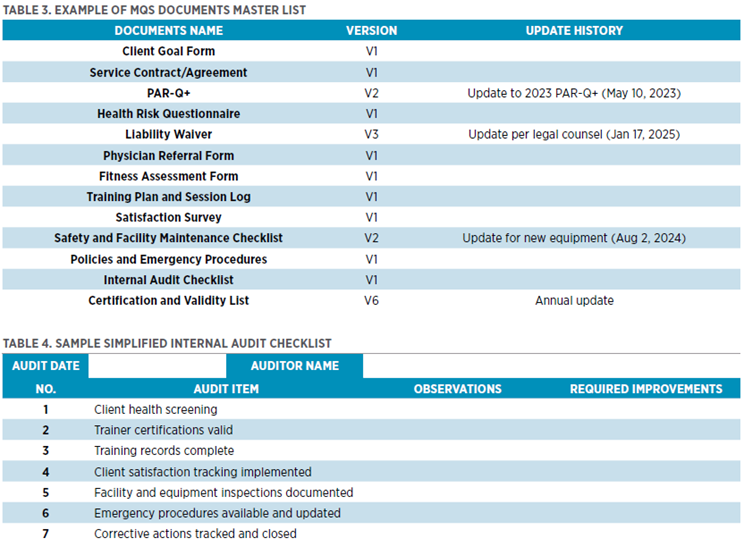
This inclusive approach encourages open discussion, improves staff engagement, and reinforces a culture of continuous improvement. Table 4 provides a sample internal audit checklist.
CERTIFICATION VALIDATION TRACKING
Tracking certification validity is essential for legal compliance and professional credibility. While many facilities display certifications publicly, this approach complicates renewal tracking. The authors recommend using an electronic certification tracking system with automated reminders—especially for staff holding multiple certifications from different organizations. A sample tracking format is provided in Table 5.
CUSTOMER SATISFACTION SURVEYS
Customer satisfaction serves as a key performance indicator (KPI) within the MQS framework. Regular surveys—conducted electronically or on paper—provide measurable insights to guide improvement efforts. To promote honest feedback, anonymous responses may be used. Table 6 includes a sample customer satisfaction survey.
FLEXIBLE APPLICATIONS OF THE MQS
Beyond the framework presented here, SMFC owners may adapt the MQS based on their specific operational needs, including:
-
- Client demographics
- Legal and regulatory requirements
- Unique safety or risk considerations
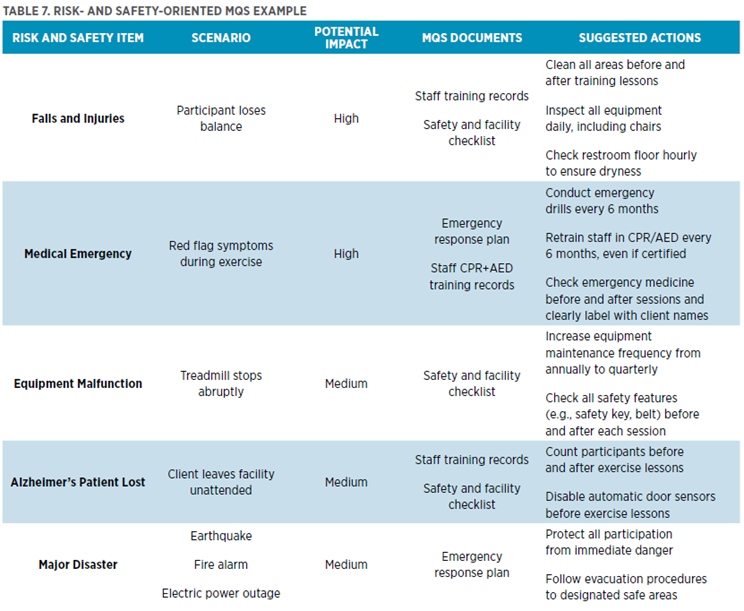
EXAMPLE: RISK-FOCUSED MQS FOR SPECIAL POPULATIONS
As an example, the authors present an MQS framework developed for a facility serving older adults and special populations.
In this setting:
-
- All participants were medically approved
- Exercise programs were reviewed by healthcare professionals
This ISO 9001–aligned framework emphasizes risk and safety management and may serve as a reference for similar facilities (Table 7).
CONCLUSION
Quality management does not require formal certification to be effective. The MQS offers a practical way for SMFCs. Personal trainers can adapt it to their own needs, whether focusing on needs, risk management, or alignment with other standards (e.g., ISO 45001 or ISO 22000). Keeping simple, usable documentation and reviewing and improving it regularly can help reduce risk, strengthen client trust, and support long-term sustainability.
This article originally appeared in Personal Training Quarterly (PTQ)—a quarterly publication for NSCA Members designed specifically for the personal trainer. Discover easy-to-read, research-based articles that take your training knowledge further with Nutrition, Programming, and Personal Business Development columns in each quarterly, electronic issue. Read more articles from PTQ »
Related Reading
References
- Baechle, TR, and Earle, RW. Essentials of Personal Training. (2nd ed.) Champaign, IL: Human Kinetics; 2020.
- Canadian Society for Exercise Physiology. PAR-Q+ and ePARmed-X+. Retrieved July 2025 from https://csep.ca.
- del Castillo-Peces, C. Impact of ISO 9001 implementation without certification on SMES’ performance: A systematic review. Total Quality Management and Business Excellence 29(1-2): 38-56, 2018.
- Goetsch, DL, and Davis, SA. Quality Management for Organizational Excellence: Introduction to Total Quality. (8th ed.) Boston, MA: Pearson; 2014.
- Hoyle, D. ISO 9000 Quality Systems Handbook. (6th ed.) Oxford, UK: Butterworth-Heinemann; 2009.
- International Organization for Standardization (ISO). ISO 9001: 2015 quality management systems—Requirements. Geneva: ISO; 2015.
- International Organization for Standardization (ISO). ISO 14001: 2015 environmental management systems—Requirements with guidance for use. Geneva: ISO; 2015.
- International Organization for Standardization (ISO). ISO 9001: 2015 Quality Management Principles. Geneva: ISO; 2015.
- International Organization for Standardization (ISO). ISO 45001: 2018 occupational health and safety management systems—Requirements with guidance for use. Geneva: ISO; 2018.
- International Organization for Standardization (ISO). ISO 22000: 2018 food safety management systems—Requirements for any organization in the food chain. Geneva: ISO; 2018.
- Johnson, P, and Davis, R. Legal risks in personal training: A survey of small gym operators. Sports Lawyers Journal 7(2): 114-121, 2019.
- Mikeska, C. Continuous quality improvement tools for personal trainers: Enhancing accountability and service quality. Journal of Strength and Conditioning Research 34(3): 850-857, 2020.
- National Strength and Conditioning Association (NSCA). Certified Personal Trainer resources. Retrieved July 2025 from https://www.nsca.com/certification/nsca-cpt/.
- National Strength and Conditioning Association. Tools and resources. Retrieved July 2025 from https://www.nsca.com/education/tools-and-resources/.
- Smith, J, and Lee, K. Quality management challenges in small fitness facilities. International Journal of Sports Science 12(4): 230-237, 2018.
Learn about the benefits of NSCA Membership »

- Privacy Policy
- Your Privacy Choices

- Terms of Use
- Retraction and Correction Policy
- © 2026 National Strength and Conditioning Association